
Tri-Rail, the commuter railroad serving three counties, is enroute to permanent derailment in a shutdown by July 2027 due to state budget cuts. Its public operators are scrambling to find ways to keep going.
The Florida Department of Transportation (FDOT) redefined what it considers the statutory minimum for funding Tri-Rail, reducing from $42.1 million to $15 million the understood statutory minimum, South Florida Regional Transportation Authority (SFRTA) Executive Director David Dech explained to a July 25 workshop. SFRTA oversees Tri-Rail.
If no changes are made, the budget cut has led the Tri-Rail’s lifeline to end in July 2027, he said.
“In [the] April board meeting,” said Mr. Dech, “we took a joint partnership agreement from FDOT to our board, where FDOT was committing $62 million, that was always contingent on the Florida budget. We understand that. And then when the Florida budget was finalized, and the doc stamp money was zeroed out, and the Florida rail enterprise was zeroed out, FDOT redefined their interpretation of the statutory minimum…. They say $15 million instead of $42.1 million, and what that really does is it forces us – we had been stretching out some covid relief funds and things like that – to try to make sure that we can continue to operate.”
Mr. Dech also shared that SFRTA can take care of some of the capital projects it wanted to get done by using those covid relief funds.
The budget “forces us to pull that money forward,” he said, “and then some of the money that we were putting towards our reserves – we built over the last few years very healthy reserves – we’re forced to pull those in and put them to operating dollars, because $1 is not $1. There’s certain dollars that are legally allowed to be used for operating and there’s certain dollars that are legally allowed to be used for capital work. There’s some that can be changed back and forth, but not very much.”
The situation is forcing SFRTA to draw back, said Mr. Dech, look at the overall picture and pull those reserves forward.
Additionally, he said, SFRTA is in “very close negotiations” with the counties to try to find additional revenue sources within the counties, “or within an additional tax or something to help supplement SFRTA.” Such efforts have been taking place for some time.
“We run about $150 million a year operating budget,” said Mr. Dech, “so about $90 million of that is not from federal sources.”
Additionally, “our contract with the state expires July of 2027,” he said. “We’ve been in the process of extending that contract.” Tri-Rail can operate its full service of trains, weekdays, weekends and the MiamiCentral service as it does today until July of 2027.
“I think this is an existential threat, this is real,” said Mr. Dech. “The counties have had their revenue reduced as well. This might have been a different conversation had – it was kind of a double whammy, we’re asking for money and then the amount of money the counties are able to bring in has been reduced. It really stresses the county budget.”
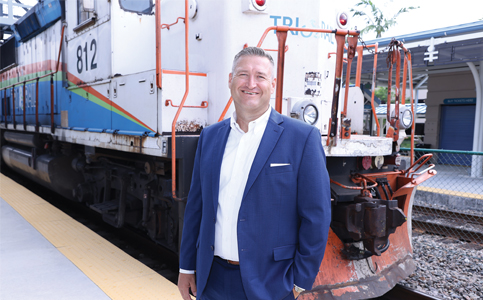
Mr. Dech explained that Palm Beach County doesn’t have a transportation surtax, which makes it difficult for Palm Beach. Additionally, “the business rental tax, which was eliminated in the budget as well, was one of the avenues by which the counties calculated their surtax money. All the counties took a financial hit as well. I think everybody’s aware of the difficulties that Miami-Dade County is having with the budget this year. This is just another real problem on top of that.”
Tri-Rail began operations in 1989 to alleviate traffic while I-95 was under construction.
“It was really meant to be a temporary solution … to relieve the pressure off I-95 temporarily,” said Mr. Dech. “It was so successful that they kept it going. Over the years, it has grown. Back in the mid ’90s, they double-tracked almost the entire 78 miles that we run. We’ve added stations. We’ve expanded down into downtown Miami, MiamiCentral.”
Just last month, said Mr. Dech, Tri-Rail broke its all-time ridership record. People continue to ride the train.
It’s still a great alternative to I-95, he said. “The people who ride our train represent one lane of traffic on I-95 in both directions. If everybody were to stop riding our train, we would have to figure out a way to build a lane or put 4.5 million more people on I-95 a year.”
Tri-Rail runs from Mangonia Park, in Palm Beach County, just north of downtown West Palm Beach, directly into the Miami International Airport, and then runs into MiamiCentral station that is shared with the Brightline.
“We have multiple sources of funding,” said Mr. Dech, “our primary source of funding was the State of Florida. That has been greatly reduced, but we get funding from the State of Florida. We have some federal funds that are based on ridership. We have funding from the counties. We have a little bit of funding from the highway administration, and then, of course, our fare revenue.”
Tri-Rail has a large segment of society that depends on it every day to get to work, he said, whether the individual owns or doesn’t own a car. SFRTA believes Tri-Rail provides a valuable public service.
“We really do think we provide great access to the airport,” said Mr. Dech. “We do represent a lane of traffic in either direction on I-95. I don’t think anybody wants all that traffic out there. I don’t think we could – I don’t know what it would cost to add a lane to I-95, but I think it would probably be significantly more than operating Tri-Rail.”
The post Tri-Rail faces 2027 shutdown without engineering a rescue appeared first on Miami Today.